A diversified enterprise specializing in food products has a decades-long legacy of driving innovation across agriculture, food technology, and industrial applications.
With a global manufacturing and distribution footprint and a workforce of over 10,000, the company partners with enterprises across consumer goods, health sciences, and industrial sectors to co-develop high-performance, nature-derived products.
The Business Challenge
Despite managing over a billion dollars in annual spend, the company lacked clarity on where the money was going and whether it was being spent effectively. They approached Oraczen with a direct question:
"We’re spending a lot, but are we spending it wisely?"
Their global operations produced massive, poor-quality accounts payable transaction data in multiple currencies and languages, often missing key attributes. Data classification was largely semi-manual, slow, and error-prone, relying on a cumbersome rule-based engine with over 15,000 to 20,000 rules, yet achieving less than 70% accuracy. This created major blind spots in spend analysis and made it impossible to view the complete picture in one place. The process was costly, inaccurate, and inefficient.
Supplier information was spread across multiple ERP systems, fragmenting visibility into spend categories. This decentralized setup prevented a unified view of global procurement operations and slowed strategic decision-making. Even after cleaning the data, their manually built centralized BI dashboard, created at significant cost and effort, lacked real-time insights. The absence of deep, actionable insights delayed decisions and reduced the enterprise’s ability to optimize costs and scale operations effectively.
Traditional AI could not manage the scale or complexity. With millions of transactions flowing monthly from various ERPs, regions, and categories, the data was distributed and unstructured. Missing descriptions, misaligned categories, and static rule-based systems failed to adapt to the client’s needs or deliver autonomous, context-aware decisions.
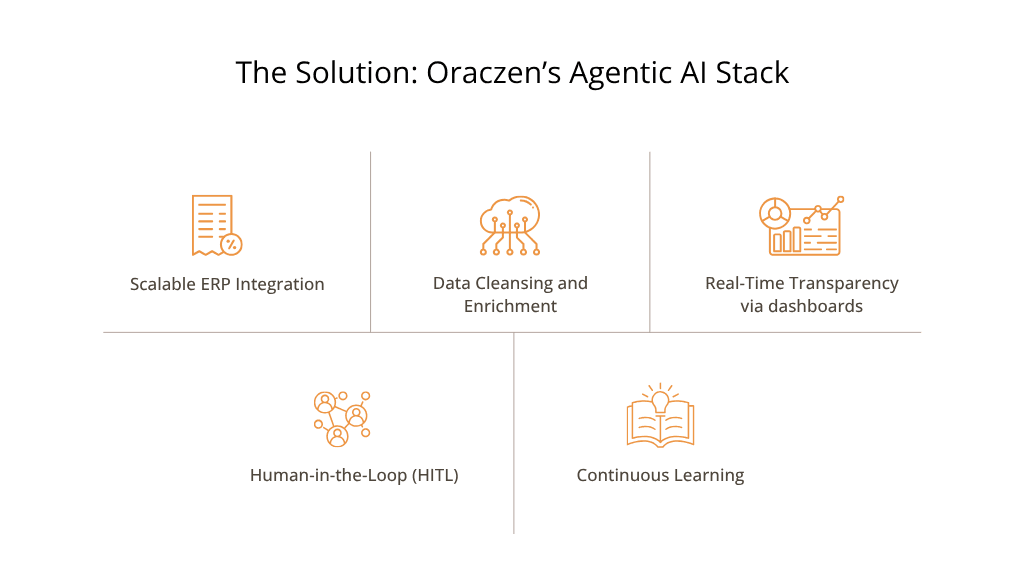
The Solution: Oraczen’s Agentic AI Stack
Oraczen’s Procurement Spend Analyzer (PSA), an agentic system powered by the Zen Platform and deployed on the client’s private cloud, brought all procurement data together to provide unified visibility and actionable insights. Unlike traditional tools, PSA’s agentic AI approach combined autonomy, adaptability, and multi-agent collaboration to transform the client’s procurement process.
How It Worked
- Integration with distributed systems: PSA integrated with multiple systems of record to consolidate and harmonize data using a broad, high-resolution taxonomy.
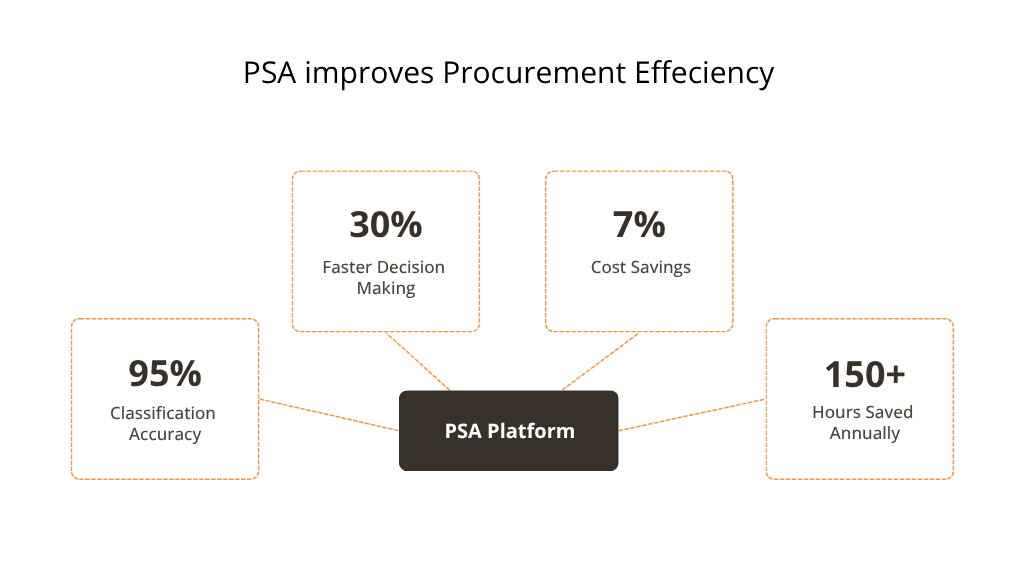
- Data cleansing and enrichment: PSA standardized and enriched transaction data across regions, filling gaps such as missing product descriptions and correcting misclassified categories. Using the client’s organizational taxonomy, it achieved 90–95% classification accuracy and 100% coverage, a significant leap from the previous 70%.
- Real-time transparency via dashboards: By extracting data directly from multiple ERPs, PSA provided a unified view of global procurement activities, enabling quick identification of unusual costs and responsible parties through charts and dashboards.
- Human-in-the-loop (HITL): A user-friendly interface allowed teams to review and refine classifications, ensuring continuous improvement.
- Continuous learning: By integrating enterprise rules and retraining continuously, PSA kept discrepancies below 5%.
The R&D team used PSA’s clustering module to uncover hidden patterns, achieving 5–10% cost optimization through supplier consolidation. Category managers relied on the Insights Agent for strategic recommendations, including market trends, risk analysis, and competitive positioning. The more teams used PSA, the more value they uncovered, moving from static dashboards to dynamic, AI-powered procurement intelligence.
Why Agentic AI?
Unlike traditional AI, PSA’s multi-agent system did not just follow rules. It reasoned, adapted, and collaborated like a team of experts. It learned from past misclassifications and integrated with tools such as Ariba for direct category corrections, using Zen’s role-based access controls for security. This adaptability made it well suited for managing complex, unstructured data at scale.
Execution Approach
The implementation unfolded over three months in clear phases:
- Proof of Concept (Week 1–4): Tested PSA on a subset of data to validate accuracy and integration.
- Data Staging (Week 5–8): Cleaned and enriched historical data, aligning it with the client’s taxonomy.
- Agent Implementation (Week 9–12): Rolled out PSA across all regions, with full ERP integration and real-time dashboards.
Orchestration logic ensured smooth data flows, while feedback loops and HITL refined the system. The Zen Platform’s APIs made integration with existing tools seamless.
Results
The impact was immediate and measurable:
- 90–95% classification accuracy, reducing misclassifications to under 5% and delivering a unified, clear view of procurement activities across all regions and categories.
- 30% faster decision-making through real-time dashboards and insights.
- 5–10% cost savings through supplier consolidation and optimized negotiations.
- 150+ person-hours saved annually per category manager by automating manual processes.
- Stronger negotiation leverage with global suppliers through real-time, data-driven insights.
- Improved R&D visibility, as PSA’s intelligent data enrichment tools helped the R&D team identify patterns and trends that were previously hidden.
Client Quote
"Oraczen’s PSA didn’t just automate our procurement. It made us smarter and faster, turning messy data into strategic wins."
— VP, Digital Transformation
Future Plans
The success of PSA has encouraged the client to expand its use to other departments, including R&D and logistics. They are exploring Oraczen’s broader AI roadmap, including additional agents for demand forecasting and inventory optimization. Long term, they aim to deepen collaboration with Oraczen to scale AI-driven automation across global operations.
Final Takeaway
Oraczen’s Agentic AI did more than clean data. It reshaped how procurement operates by transforming fragmented, unstructured transactions into real-time, trusted insights. PSA unlocked intelligence that drives faster, more confident decision-making. The future of procurement is not just digital. It is agentic.