
Clearing the Enterprise data fog with AI-driven classifications and Agentic spend analysis
Procurement, Supply Chain



Pallavi Khutal
Jun 4 2025
Industry
Procurement / Finance
Use Case
Automated Multi-Taxonomy Spend Classificationn
Solution Type
PSA Classification Capability Powered by Zen Platform
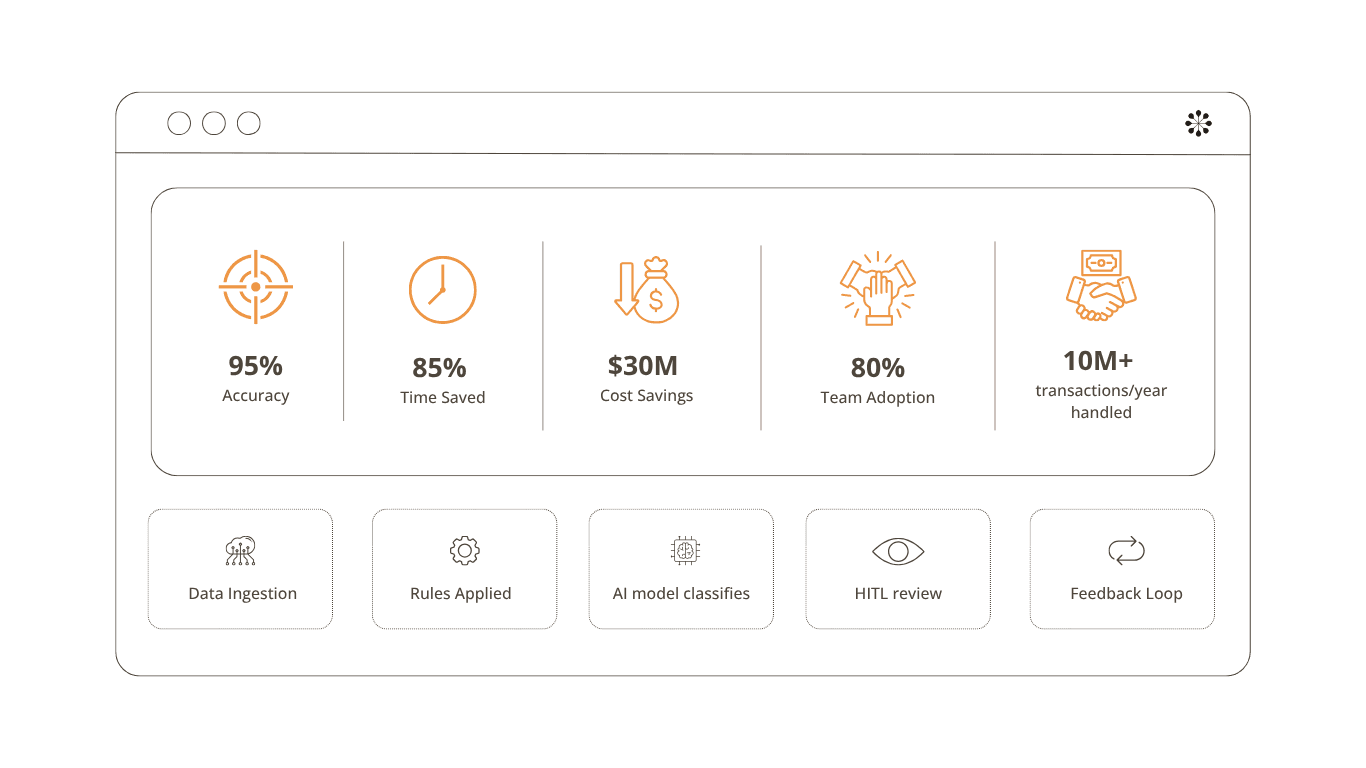
A Fortune Global 500 manufacturer with $15 billion in annual revenue faced a persistent procurement challenge: millions of annual transactions had to be classified across multiple taxonomies with high accuracy, speed, and compliance. Inconsistent naming, free-text purchase descriptions, and decentralized procurement structures made reliable classification difficult to scale. Manual processes consumed 12,000 hours annually and delivered a 20% misclassification rate. PSA, an agentic system built on Oraczen’s Zen Platform, deployed an AI-driven classification capability combining machine learning, Retrieval-Augmented Generation (RAG), large language models (LLMs), and human-in-the-loop (HITL) oversight. The result: 95% classification accuracy, 85% time savings, and $30 million in identified cost-saving opportunities.
Enterprise procurement classification is increasingly automated using AI, particularly for complex, multi-taxonomy environments. According to a 2024 BCG report, 60% of large enterprises plan AI investments exceeding $25M, with procurement a key focus area. HITL classification models are gaining traction as they balance automation efficiency with compliance, accuracy, and enterprise-specific rules.
The client’s classification challenge included:
PSA’s classification capability addressed these issues through an integrated AI workflow
1. Input Data Integration
- Procurement taxonomy with 200+ categories
- Historical expense data from ERP, including supplier names, descriptions, and amounts
2. Enterprise Rule Encoding
- Sister company exclusions
- Category overrides for specific suppliers
- Non-sourceable transaction flags
3. Model Training
- Random Forest and Gradient Boosting trained on multi-year expense data to capture seasonal and category patterns
4. Real-Time Classification
- AI model classifies incoming transactions against taxonomy
- RAG retrieves matching historical classification and rules
- LLM analyses new or ambiguous entries using NLP for best-fit category inference
5. HITL Oversight
- Low-confidence classifications (score < 0.7) routed for human review
- Reviewer corrections fed back for continuous retraining
6. Continuous Improvement
- Six-month retraining cycles improved accuracy from 92% at pilot to 95% at scale
Chief Procurement Officer:
“PSA has freed our team from repetitive work while maintaining classification accuracy at a scale we could not achieve manually. The system adapts to our rules and taxonomies without disrupting existing processes.”
Procurement Analytics Lead:
“The HITL interface is intuitive. We’ve closed the gap between AI predictions and our internal standards while keeping pace with transaction volumes.”
By combining machine learning, RAG, LLMs, and HITL review, PSA on the Zen Platform delivered enterprise-grade, multi-taxonomy spend classification at scale.
The solution has set a repeatable model for AI-driven procurement analytics in global organizations, improving accuracy, efficiency, and decision-making resilience.
Extracting and cleaning three years of transaction data from the client’s ERP system, addressing inconsistencies in naming and free-text descriptions.
Working with the procurement team to define and encode enterprise-specific classification rules, ensuring alignment across decentralized units.
Training the model on historical data and validating it on a holdout dataset, achieving an initial accuracy of 92%.
Conducting workshops to train the procurement team on the HITL interface and interpreting accuracy scores.
Rolling out the model in phases, starting with a pilot for the logistics and IT spend categories before scaling to all categories, ensuring compatibility with multiple taxonomies.
The deployment of Oraczen’s AI-powered spend classification model yielded transformative results for the client’s procurement operations:
The model achieved a 95% classification accuracy rate, reducing misclassifications from 20% to less than 5%. This improved the reliability of spend analytics and sourcing strategies.
Manual classification time was reduced by 85%, from 12,000 hours to 1,800 hours annually. This freed up procurement professionals to focus on strategic tasks like supplier negotiations and sustainability initiatives.
Accurate classifications enabled the identification of $30 million in annual cost-saving opportunities through optimized supplier selection and contract negotiations.
Improved Classification Accuracy Through HITL Feedback
Following the initial deployment of Oraczen’s AI-powered spend classification model, iterative feedback loops were implemented using human-in-the-loop (HITL) corrections and model retraining. As a result, discrepancies between the AI-classified and original category spend percentages were significantly reduced. For example, as shown in the latest evaluation, the AI’s predicted spend shares now differ by less than 1% from the original across all Level 1 taxonomy categories. This demonstrates the model’s ability to self-correct and improve through continued exposure to enterprise-specific data and expert validation—resulting in highly reliable and consistent spend classification over time.
The success of Oraczen’s solution is reflected in the feedback from key stakeholders at the Fortune Global 500 client:
Chief Procurement Officer:
“Oraczen’s AI-powered spend classification model has been a game-changer for our procurement operations. The 85% reduction in manual classification time has allowed our team to focus on strategic initiatives, while the 95% accuracy ensures we’re making data-driven decisions with confidence.”
Procurement Analytics Lead:
“The human-in-the-loop interface is intuitive and empowers our team to refine classifications seamlessly. The model’s ability to handle our complex taxonomy and enterprise rules has significantly improved our spend visibility.”
IT Director:
“Integrating Oraczen’s solution into our existing systems was smooth, and the scalability of the model has supported our growing transaction volumes without compromising performance.”
The procurement industry is undergoing a significant transformation driven by AI adoption. According to a 2024 study by BCG, 60% of enterprise companies plan to invest over $25 million in AI-related projects, with procurement being a key focus area. Key market trends include:
Up to 94% of procurement teams now leverage AI tools, particularly for spend analytics and supplier management.
GenAI is increasingly used for tasks like contract analysis and supplier communication summarization, enhancing efficiency.
AI is being applied to evaluate supplier ESG performance, aligning with corporate sustainability goals
HITL models are gaining traction to balance automation with human expertise, ensuring fairness and compliance. Oraczen’s solution aligns with these trends by combining ML, RAG, LLMs, and HITL capabilities to deliver a robust and future-ready procurement platform.
Oraczen’s AI-powered spend classification model has redefined procurement operations for the Fortune Global 500 client and set a benchmark for the industry:
Automation of repetitive classification tasks reduced processing times by 70%, enabling faster decision-making.
Accurate spend categorization provided actionable insights into spending patterns, supplier performance, and market trends, empowering strategic sourcing.
The model’s ability to flag low-confidence classifications and incorporate enterprise rules minimized errors and ensured compliance with internal policies.
By reducing manual workload, procurement teams could prioritize high-value activities like supplier relationship management and innovation.
The client gained a competitive edge by leveraging AI to optimize costs and respond proactively to market changes, aligning with Industry 4.0 principles.
Oraczen’s AI-powered spend classification model has transformed the procurement operations of a top Fortune Global 500 manufacturing client, delivering 95% accuracy, 85% time savings, and $30 million in cost-saving opportunities. By addressing the multifaceted procurement classification problem—including inconsistent naming, free-text descriptions, multiple taxonomies, and decentralized procurement—Oraczen ensured reliable and scalable spend categorization.
The model’s use of a RAG system to first retrieve relevant information, followed by LLM classification for novel cases, optimized the process for efficiency and accuracy. The flowchart illustrates the end-to-end process, highlighting the model’s ability to self-improve, as evidenced by reduced discrepancies in spend percentages across taxonomy categories. The enthusiastic testimonials from the client’s leadership further underscore the solution’s impact on efficiency, decision-making, and strategic focus. As AI adoption continues to accelerate, Oraczen remains at the forefront, empowering procurement teams to navigate the challenges of a dynamic global market.